"Safety pays off" - what is a risk assessment, why is it a vital part of the CE marking of a machine, and how can it help you as a machine manufacturer?
The Machinery Directive 2006/42/EC and the upcoming Machinery Regulation (EU) 2023/1230 require every machine manufacturer to carry out a risk assessment. This is a legal requirement.
This also applies to self-built machines. If you manufacture a machine for your own use - even as a single unit - you are legally considered the manufacturer. This means you have the same responsibilities as a commercial machine manufacturer and must CE mark your machine. To CE mark a machine, a proper risk assessment is required, among other things.
The same applies when several machines are interconnected into a system also known as "assembly of machinery". Under the Machinery Directive, such interconnected machines must be regarded as a whole. Therefore, when you build a system of multiple machines, a new combined machine is, in practice, created.
This means the entire system must be risk assessed - not just the individual machines separately.
The conclusion is clear: whether you build, modify, or interconnect machines, a risk assessment is required to meet the legal requirements under the Machinery Directive and the upcoming Machinery Regulation.
Read more about how you conduct a risk assessment in our article "Risk assessment for machinery in 5 steps"
What is a risk assessment and why is it so important?
A risk assessment is a systematic process to:
Identify hazards
Assess risks
Reduce risks to an acceptable level
Risk is assessed based on two factors:
How likely it is that an accident occurs
How severe the injury will be
The higher the likelihood and severity, the higher the risk.
The goal is for the machine to be safe to use - this work starts already at the design stage and follows the machine throughout its entire lifecycle.
The risk assessment is the most important part of the technical documentation also known as the technical file required for CE marking of machinery. For more information on how to CE mark a machine, you can read our article “CE Marking of a Machine - Requirements, Process and Technical Documentation”.
How should risk assessments and risk reductions be carried out?
A risk assessment must be performed, and the work starts by defining the limits of the machine. This means clarifying what the machine is intended to be used for, who will use it, and under which conditions it will be used. This understanding forms the basis of the entire risk assessment.
Next, all relevant hazards are identified. This includes not only normal operation, but the machine’s entire lifecycle - from transport to decommissioning and all stages in between. The purpose is to capture all situations where people may be exposed to risk.
Once hazards have been identified, risks are assessed by weighing the likelihood that an event occurs and how severe the consequences may be. Based on this, it is determined whether the risk is acceptable or needs to be reduced.
Risk reduction is based on the so-called three-step method. It specifies the order in which risks must be handled and is fundamental to all safety work in machine design.
Step 1 - Inherently safe design measures
Inherently safe design means that risks are eliminated or reduced through the way the machine is designed.
This may involve designing the machine so hazards are designed out, or reducing risk in the interaction between people and the machine.
Step 2 - Technical protective measures
If risks cannot be eliminated by design, they must be reduced through technical guards or complementary protective measures.
This includes, for example, guards, safety functions, and other technical solutions, taking into account both intended use and reasonably foreseeable misuse.
Step 3: Information for users
If risks remain despite inherently safe design and technical protective measures, these must be clearly described in the information for use.
The information must include, among other things, how the machine is to be used safely, adapted to the user’s capabilities, recommended working methods, and training needs
warnings and information about residual risks throughout the machine’s entire lifecycle.
Which personal protective equipment is required, why it is needed, and what training is required to use it.
It is important to remember that information must never replace design measures or technical protection.
What does this mean in practice?
If the risk is not acceptable, measures must be taken to reduce it. The process is then repeated - new hazards may arise and previous risks need to be re-evaluated. The work continues until all risks have been reduced to an acceptable level.
It is important to understand that risk assessment is not an activity carried out at the end of a project. It should start early and run in parallel with design. By identifying risks at an early stage, they can often be resolved directly in the design, which is both more efficient and more cost-effective than late changes before or during commissioning.
Common challenges and pitfalls
In theory, risk assessment is a clear process, but in practice challenges often arise. The greatest difficulty is identifying all relevant hazards. Machines can be complex systems, and risks can arise in situations that are not obvious at first glance. This is particularly true in unusual operating scenarios, such as maintenance when guards are removed, or in foreseeable incorrect behaviors - for example, when an operator bypasses a safety function to save time. Systematically capturing all these situations across the machine’s entire lifecycle is one of the most demanding parts of the work.
Here, standards and checklists play an important role. Specific machine-type standards often include examples of typical hazards, which can serve as support to ensure nothing is overlooked.
Another common pitfall is the false sense of security that “nothing has happened before.” Many companies have long experience and build machines that perform well in practice. But without a documented risk assessment, traceability is lacking. If an accident occurs later, it must be possible to show which risks were identified and how they were managed. A systematic risk assessment ensures exactly this and reduces the risk that important aspects are overlooked.
Documentation is in itself a challenge. It is mandatory and must clearly show which machine has been assessed, which requirements apply, which hazards were identified, which measures were taken, and which risks, if any, remain. It must also state which standards have been applied. The documentation serves both as internal knowledge support and as a basis during reviews by authorities. At the same time, relevant information from the risk assessment must be transferred to the operating instructions so that the user is informed about residual risks and necessary protective measures.
A recurring mistake is to treat risk assessment as a formality carried out late in the project. This often leads to generic documents that do not reflect the actual machine or its risks. When risk assessment is instead integrated early in the development process, risks can be handled directly in the design. This reduces the need for late changes and contributes to both safer and more cost-effective solutions.
Counterarguments and other perspectives
There are often objections to risk assessment. Common arguments are that it takes time, costs money, or inhibits innovation. Others believe that experienced engineers already have sufficient knowledge and that formal documentation is therefore unnecessary. These views are understandable, but they do not fully hold.
In practice, safety and innovation are not in conflict with each other. On the contrary, a well-thought-out risk assessment can contribute to better solutions. When risks are addressed early in design, the machine can be designed more efficiently, without relying on extensive retrofitted protection. This often provides better functionality, higher ergonomics, and a more thoroughly engineered product.
The cost argument is also frequently raised. It is true that a thorough risk assessment requires time and competence. But in a broader perspective, it is an investment. Every risk identified and eliminated in advance reduces the likelihood of accidents, downtime, and subsequent costs. The consequences of an accident can be far more extensive - both financially and in terms of loss of trust.
Another common misconception is that a risk assessment under occupational health and safety rules would be sufficient. Here, it is important to distinguish responsibilities. The risk assessment carried out under occupational health and safety rules concerns how a machine is used in a specific operation and is the employer’s responsibility. The risk assessment under the Machinery Directive, however, is the manufacturer’s responsibility and concerns the machine itself, regardless of where it is used. These two perspectives complement each other, but do not replace each other.
Overall, risk assessment is not about administration for its own sake. It is a tool for making better decisions, creating safer products, and ensuring that both legal and practical requirements are met.
Conclusion: Safety pays off
At first glance, risk assessment may be perceived as time-consuming, but in practice it is a central part of robust and sustainable machine development. It is not about administration, but about systematically ensuring that risks are identified and managed before they lead to problems.
Experience shows that machines developed with a structured risk assessment become safer and better engineered. Today, risk assessment is a natural part of the development process, and with new technology it will become even more important for managing new types of risks.
Companies that work consistently with risk assessment gain clear advantages. They reduce the risk of accidents, downtime, and legal consequences. At the same time, they fulfill their obligations under the Machinery Directive and strengthen trust among both customers and users. A machine where safety is considered in every detail signals responsibility and quality.
The opposite scenario is significantly more costly. In the event of an accident, the risk assessment will be scrutinized. If it is missing or deficient, the consequences can be extensive - from production stoppages to legal action and reputational damage.
A completed and documented risk assessment is therefore not only a requirement for CE marking. It is an investment in safe operation, regulatory compliance, and long-term business value.
How does Noex help with risk assessments?
Working in a structured way with risk assessment requires methodology, knowledge, and time. For many organizations, the challenge is not understanding what needs to be done - but actually getting it done effectively and consistently in every project.
This is where Noex comes in. The platform is developed to support machine manufacturers throughout the entire risk assessment process - from identifying relevant requirements and standards to documenting, structuring, and following up the work. By gathering everything in one place, it becomes easier to work systematically, ensure compliance, and create the required traceability.
The result is not only that legal requirements are met, but also that risk assessment becomes an integrated and value-creating part of the development process - instead of something done afterwards.

What are the implications of the Cyber Resilience Act (CRA) for machinery manufacturers - and what steps must you take?
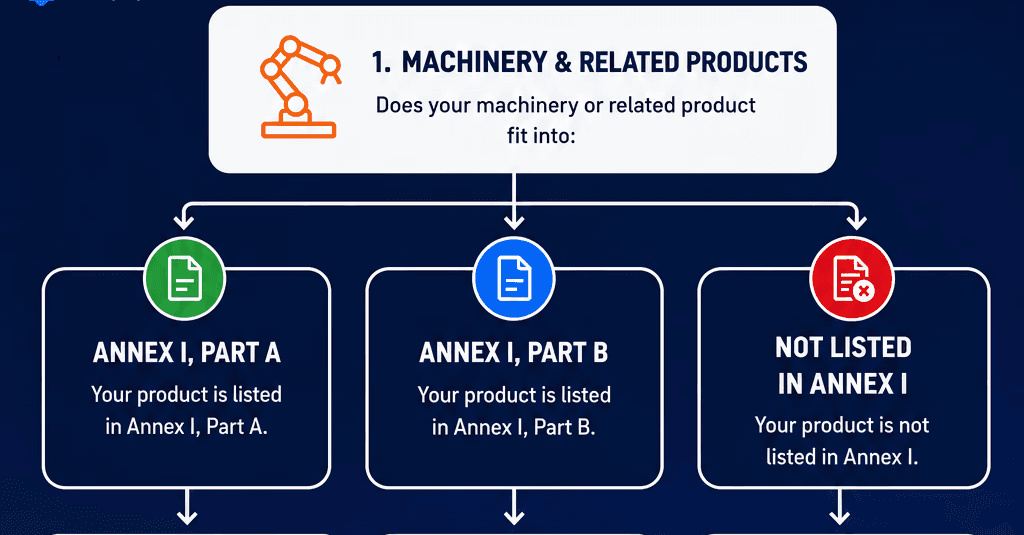
Annex IV becomes Annex I in the Machinery Regulation - what are the implications of this change?

Noex and SIS enter into a licensing agreement - standards integrated directly into the platform