Annex IV becomes Annex I in the Machinery Regulation - what are the implications of this change?
From Annex IV to Annex I - a critical transition in the new Machinery Regulation
During our discussions with manufacturers, machine builders, and automation firms, we have observed that certain sections of the new Machinery Regulation (EU) 2023/1230 generate more questions than others.
One of the most frequently discussed changes is the transition from the former Annex IV of the Machinery Directive 2006/42/EC to Annex I of the Machinery Regulation.
At first glance, many find the new structure difficult to interpret. We have therefore prepared a simplified guide to help establish a clearer understanding of how the regulations are structured and what they entail in practice.
What has changed?
The Machinery Directive featured Annex IV, which listed machinery and safety components considered to pose high levels of risk.
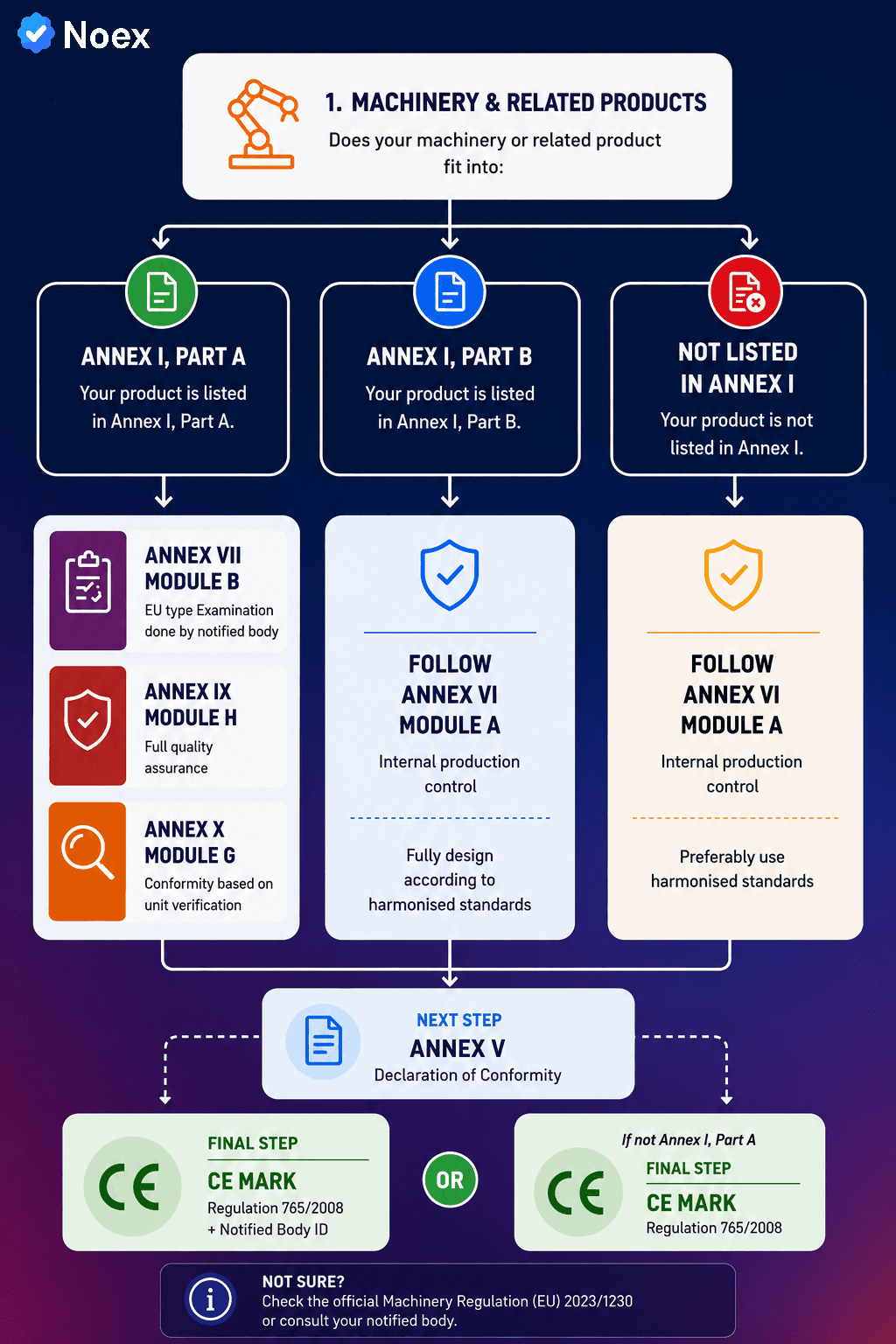
Under the new Machinery Regulation, these product categories are now located in Annex I. The primary structural shift is that this Annex is now divided into two separate sections - Part A and Part B - which are linked to different conformity assessment procedures under Article 25.
Consequently, manufacturers must understand both which category their product falls under and the implications this has for the CE marking process.
Annex I - Part A
Part A includes, among others, the following categories:
Removable mechanical transmission devices and their guards
Vehicle servicing lifts
Portable cartridge-operated fixing and other impact machinery
Safety components with fully or partially self-evolving behaviour using machine learning approaches ensuring safety functions
Machinery embedding systems with fully or partially self-evolving behaviour using machine learning approaches ensuring safety functions
One of the most significant updates is that safety-related systems using machine learning are now explicitly regulated. This reflects the growth of intelligent control systems and AI-related technologies in industrial applications.
You can view the complete list of Part A categories further down in the FAQ section.
Annex I - Part B
Part B includes, among others:
Circular saws
Band-saws
Thicknessers for one-side dressing
Planers
Tenoning machines with manual feed
Combined machines for woodworking
Chainsaws
Presses for the cold working of metals
Injection or compression plastics-moulding machines and rubber-moulding machines
Machinery for underground work
Household refuse collection vehicles with a compression mechanism
Devices for the lifting of persons or of persons and goods involving a risk of falling from a vertical height of more than three metres
Protective devices designed to detect the presence of persons
Power-operated interlocking movable guards
Logic units to ensure safety functions
Roll-over protective structures (ROPS)
Falling-object protective structures (FOPS)
These product categories have long been classified as high-risk and are consequently subject to specific conformity assessment procedures.
You can view the complete list of Part B categories further down in the FAQ section.
What does this mean for manufacturers?
For manufacturers, this change underscores the critical need to identify the following early in the project lifecycle:
Whether the product falls under Annex I, Part A or Part B
Which conformity assessment procedures are mandatory
Which harmonised standards are applicable
How the risk assessment must be executed and documented
Want to read more about machinery risk assessments? See our article here.What technical technical documentation needs to be compiled
Addressing these questions early significantly streamlines the CE marking process and technical file compiled further down the line.
Want to read more about CE marking and the required contents of the technical file? See our article here.
More than just a change of annex numbering
A common simplified description is that "Annex IV has become Annex I." While this provides a general overview, the structural reality is more nuanced.
It is not merely a change in numbering. Product categories have been restructured and linked to specific conformity assessment pathways. Furthermore, new categories have been introduced to address evolving technologies, such as safety functions managed by machine learning algorithms.
For many manufacturers, this requires a deeper understanding of practical regulatory application.
Growing demand for practical compliance guidance
An evident trend in the industry is the demand from manufacturers for actionable guidance on how to translate new regulatory frameworks into effective engineering workflows.
Most organisations recognise the critical importance of compliance, yet many struggle to align regulatory requirements, risk assessments, harmonised standards, and technical documentation throughout the product development process.
This is where structured methodologies and digital tools become indispensable.
By adopting a systematic approach to risk assessment, requirements management, and technical documentation, organisations can establish robust traceability, streamline internal processes, and increase reliability in their CE marking projects.
The future of machinery safety requires smarter workflows
The Machinery Regulation is a clear demonstration of how European legislation evolves alongside technological progress.
Machinery is increasingly interconnected, automated, and software-driven. This evolution is met with heightened requirements for documentation, traceability, and functional safety management.
For manufacturers, this means that machinery safety and CE marking integration must be a core part of the design phase—rather than a compliance step handled at the end of a project.
Understanding the distinction between the legacy Annex IV and the new Annex I is a crucial step towards building efficient and future-proof regulatory compliance processes.
FAQ - Annex I of the Machinery Regulation (EU) 2023/1230
What is Annex I in the Machinery Regulation?
Annex I contains the categories of machinery and related products subject to specific conformity assessment procedures pursuant to Article 25 of the Machinery Regulation (EU) 2023/1230.
The Annex replaces the former Annex IV of the Machinery Directive 2006/42/EC and is divided into two sections: Part A and Part B.
Is Annex I the same as the former Annex IV?
Not entirely.
Most product categories previously listed in Annex IV are now found in Annex I, but the structure has changed. Annex I is divided into two parts connected to different conformity assessment procedures under Article 25 of the Machinery Regulation.
What is the difference between Part A and Part B?
Part A and Part B contain different categories of machinery and related products.
The two parts are linked to different conformity assessment procedures according to Article 25 of the Machinery Regulation. The applicable procedure depends, among other things, on the specific product category and how the manufacturer chooses to demonstrate conformity with the applicable requirements.
Which machinery is covered by Annex I of the Machinery Regulation?
Annex I to the Machinery Regulation (EU) 2023/1230 lists the following categories of machinery and related products subject to specific conformity assessment procedures.
Part A
Removable mechanical transmission devices, including their guards.
Guards for removable mechanical transmission devices.
Devices for the lifting of vehicles.
Portable cartridge-operated fixing and other impact machinery.
Safety components with fully or partially self-evolving behaviour using machine learning approaches ensuring safety functions.
Machinery embedding systems with fully or partially self-evolving behaviour using machine learning approaches ensuring safety functions that have not been placed independently on the market, in respect only of those systems.
Part B
Circular saws (single- or multi-blade) for working with wood and material with similar physical characteristics or for working with meat and material with similar physical characteristics.
1.1 Sawing machinery with a fixed tool during operation, having a fixed bed or support for the workpiece with manual feed or with a demountable power feed.
1.2 Sawing machinery with a fixed tool during operation, having a manually operated reciprocating saw-bench or carriage.
1.3 Sawing machinery with a fixed tool during operation, having a built-in mechanical feed device for the workpieces, with manual loading and/or unloading.
1.4 Sawing machinery with a movable tool during operation, having a mechanical movement of the tool, with manual loading and/or unloading.
Hand-fed surface planing machinery for woodworking.
Thicknessers for one-side dressing with a built-in mechanical feed device for the workpieces, with manual loading and/or unloading.
Band-saws with manual loading and/or unloading for working with wood and material with similar physical characteristics or for working with meat and material with similar physical characteristics.
4.1 Sawing machinery with a fixed tool during operation, having a fixed or reciprocating table or support for the workpiece.
4.2 Sawing machinery with the tool fitted on a carriage with a reciprocating motion.
Combined machinery of the types referred to in points 1 to 4 and in point 7 for working with wood and material with similar physical characteristics.
Hand-fed tenoning machinery with several tool holders for woodworking.
Hand-fed vertical spindle moulding machinery for working with wood and material with similar physical characteristics.
Portable chainsaws for woodworking.
Presses, including press-brakes, for the cold working of metals, with manual loading and/or unloading, whose movable working parts may have a travel exceeding 6 mm and a speed exceeding 30 mm/s.
. Injection or compression plastics-moulding machinery with manual loading or unloading.
. Injection or compression rubber-moulding machinery with manual loading or unloading.
. Machinery for underground work:
Locomotives and brake-vans.
Hydraulic-powered roof supports.
. Manually loaded trucks for the collection of household refuse incorporating a compression mechanism.
. Devices for the lifting of persons or of persons and goods involving a hazard of falling from a vertical height of more than 3 metres.
. Protective devices designed to detect the presence of persons.
. Power-operated interlocking movable guards designed to be used as protective devices in machinery referred to in points 9, 10 and 11.
. Logic units to ensure safety functions.
. Roll-over protective structures (ROPS).
. Falling-object protective structures (FOPS).
What is a "high-risk machine" under the Machinery Regulation?
The term "high-risk machine" is commonly used within the industry to describe the machinery and related products listed in Annex I to the Machinery Regulation.
However, it is important to note that the Machinery Regulation does not use this term as a formal legal definition. Instead, Annex I identifies the product categories subject to the specific conformity assessment procedures pursuant to Article 25.
This is because these machines or related products can present significant risks if they are not correctly designed, manufactured, installed, or validated.
When is a notified body required under the Machinery Regulation?
This is one of the most common questions regarding the new Machinery Regulation.
For products in Annex I Part A
For the product categories listed in Annex I Part A, one of the procedures referred to in Article 25(2) must be applied.
This means the manufacturer must use a procedure that involves a notified body in the conformity assessment.
For products in Annex I Part B
For the product categories listed in Annex I Part B, one of the procedures referred to in Article 25(3) must be applied.
If the manufacturer has fully applied harmonised standards, the references of which have been published in the Official Journal of the European Union, or common specifications covering all relevant essential health and safety requirements, internal production control may be used.
If such standards or specifications do not exist, or do not cover all relevant requirements, a notified body must be involved through one of the procedures set out in Article 25(3).
Does Annex I affect the CE marking process?
Yes.
If a machine or related product falls within the scope of Annex I, the manufacturer must ensure that the correct conformity assessment procedure is applied and that all applicable requirements of the Machinery Regulation are met before the product is placed on the market or put into service.
How do I know if my machine is covered by Annex I?
First, you need to identify the specific type of machinery or related product in question.
Next, compare the product against the categories listed in Annex I to determine which requirements and procedures apply.
This analysis should be performed early in the development or design phase, as it can affect the risk assessment, the choice of standards, and the overall conformity assessment process.
How does Annex I affect the risk assessment?
Annex I does not change the requirement to perform a risk assessment.
However, it makes it even more critical that the risk assessment clearly documents how hazards have been identified, analysed, and mitigated, and how the applicable health and safety requirements have been met.
The risk assessment remains a core component of the technical documentation and is fundamental to demonstrating that the machinery complies with the Machinery Regulation.
Do I still need to use harmonised standards?
No.
The Machinery Regulation does not mandate the use of harmonised standards.
However, harmonised standards are often the most effective way to demonstrate compliance with the relevant essential health and safety requirements. If a harmonised standard is correctly applied, it normally confers a presumption of conformity with the requirements covered by that standard.
What should manufacturers do now?
Manufacturers should:
Map out which products are affected by the Machinery Regulation.
Identify whether their products are covered by Annex I.
Ensure that risk assessments are up to date.
Review which harmonised standards are being applied.
Review procedures for technical documentation and CE marking.
Train relevant personnel on the new requirements.
Assess whether a notified body needs to be involved.
By initiating this process in good time, the transition to the Machinery Regulation will be significantly easier to manage.
How can Noex help?
Noex assists manufacturers, machine builders, and system integrators in structuring their work with risk assessments, requirements management, CE marking, and technical documentation.
Through digital workflows, traceable documentation, and compliance support, we simplify the management of both current and future machinery safety and CE marking requirements.
Annex IV becomes Annex I in the Machinery Regulation - what are the implications of this change?

Noex and SIS enter into a licensing agreement - standards integrated directly into the platform
CE marking of a machine when no C-type standard exists - how machine manufacturers should proceed in practice.