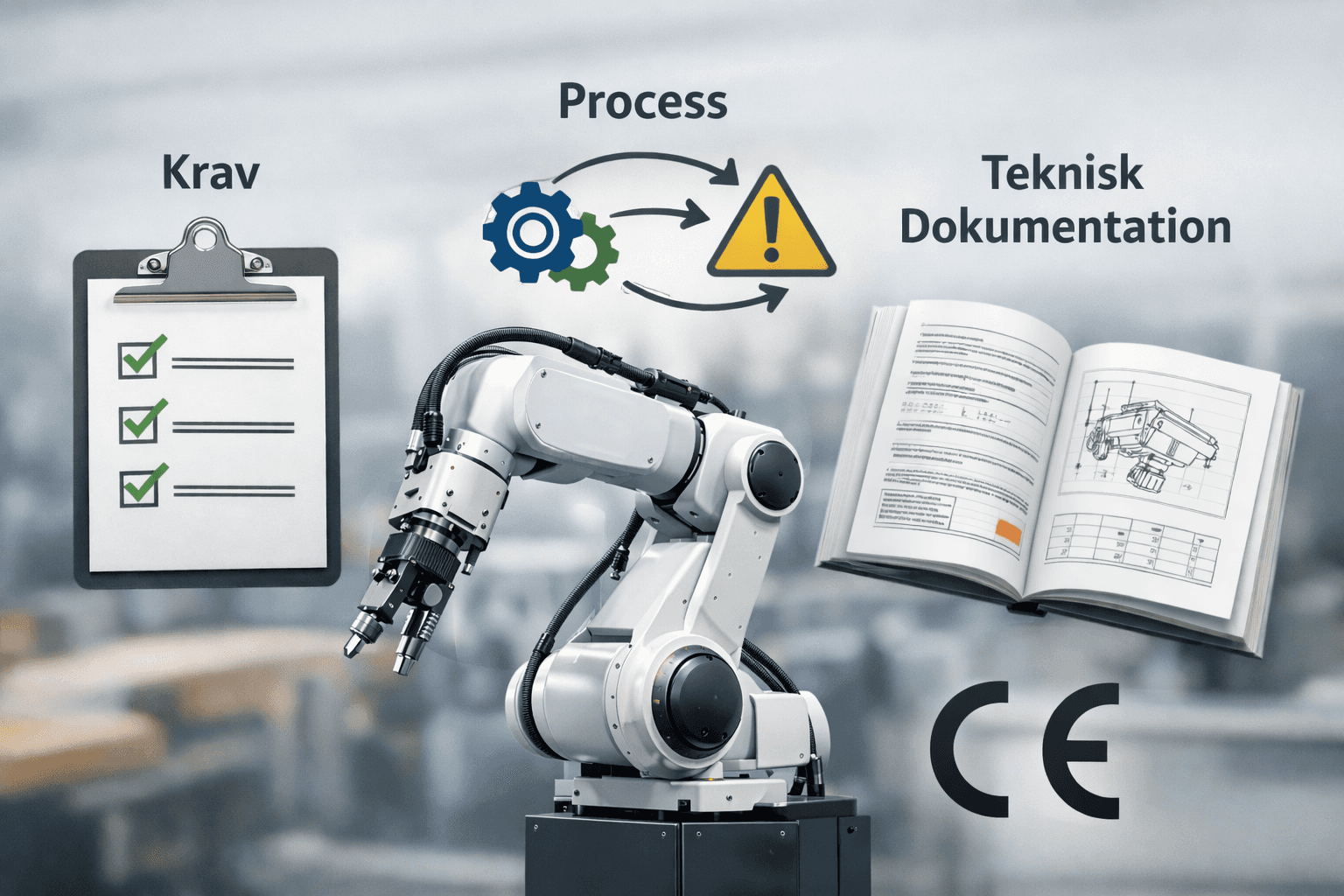
What does CE marking of a machine mean?
CE marking of a machine means that the manufacturer declares that the machine meets the EU’s essential health and safety requirements in the Machinery Directive 2006/42/EC or the forthcoming Machinery Regulation (EU) 2023/1230, and that the machine may therefore be placed on the market and put into service within the EU.
In practice, this means that you, as the manufacturer, assume full responsibility for the machine being safe - both technically and legally.
To CE mark a machine, the following are required:
Verify applicable directives and standards
A risk assessment covering risks, measures and verification - Read more about how to perform a risk assessment in our article "Risk assessment for machines in 5 steps".
Technical documentation demonstrating how the requirements are met - See exactly what the technical documentation must contain here.
Instructions for use
EU Declaration of Conformity
CE marking
When is CE marking required?
CE marking is required when a machine:
Is sold within the EU
Is first put into service
Is modified in a way that affects safety
Is imported from a country outside the EU
When is CE marking not required?
CE marking is not required for:
Machines manufactured before 1995
Machines outside the scope of the directive
Partly completed machinery
However, it is important to understand that these must still be safe.
In practice, this means that risk assessment and safe use requirements still apply.
CE marking often involves several regulatory frameworks
A common misconception is that CE marking is only about the Machinery Directive or the Machinery Regulation.
In many cases, the machine is also subject to:
Low Voltage Directive (LVD)
EMC Directive
ATEX (explosive atmospheres)
Pressure Equipment Directive (PED)
This means that CE marking is, in practice, an overall assessment of several regulatory frameworks - not a single check.
When multiple machines are integrated
This is an area where many make mistakes - and where the consequences can be significant.
What is an integrated machine?
An integrated machine consists of several machines assembled into a functional whole, where:
they operate together
they are interdependent
they are controlled jointly
The decisive factor is therefore not how they are physically connected - but that they function as a system.
You become the manufacturer - regardless of role
When you integrate machines into a whole, you are legally regarded as the manufacturer.
This also applies even if:
all machines are CE marked individually
they come from different suppliers
This is one of the most common misconceptions in industry.
The whole is regarded as a new machine
When machines are integrated, a new machine arises from a legal perspective.
This means that:
the entire system must comply with the requirements
CE marking must be carried out again
the documentation must cover the whole system
Read more about CE marking of integrated machinery in our article Integrated machinery - who is responsible for CE marking?
A new risk assessment is required - always
One of the most common deficiencies in practice is relying on existing risk assessments.
That is not sufficient.
A new risk assessment must always be performed for the entire system and should focus specifically on:
interfaces between machines
control systems
sequences and dependencies
stop functions and emergency stops
This is often where the real risks arise.
Read more about how to perform a risk assessment in our article "Risk assessment for machines in 5 steps"
CE marking of a machine - step by step
1. Identify applicable regulatory frameworks
Start by determining which directives or regulations apply to your machine.
Common regulatory frameworks:
Machinery Directive / Machinery Regulation
Low Voltage Directive (LVD)
EMC Directive
ATEX
Pressure Equipment Directive (PED)
2. Harmonised Standards
Determine which standards are applicable to your machine.
3. Risk assessment
The risk assessment must cover the entire lifecycle:
design
construction
operation
maintenance
cleaning
transport
troubleshooting
misuse
disposal
Risk reduction (part of the risk assessment process)
Risks shall be addressed in the following order:
Eliminate hazard sources
Implement technical safeguards
Inform about residual risks
The Noex platform helps you perform a correct risk assessment aligned with legal requirements.
4. Technical documentation
The documentation must demonstrate how the requirements are met - not merely that they are met (read more below)
5. Instructions for use
The instructions for use must be clear, understandable and adapted to the user in the correct language.
6. Determine whether a notified body is required
Check whether you can perform your own assessment (internal control) or whether a notified body must be involved
7. EU Declaration of Conformity
This is the legal evidence that the machine complies with the requirements.
8. CE marking
The CE marking must be visible, legible and durable.
What must technical documentation contain?
Technical documentation must show how the machine meets the essential requirements.
It shall include:
Description of the machine and its function
Risk assessment
Protective measures and residual risks
Drawings and control systems
Calculations and verifications
Standards applied
Test results
Instructions for use
EU Declaration of Conformity
Where applicable, also:
Documentation for partly completed machinery
Documentation for incorporated products
Procedures for series production
This is the documentation that is reviewed during an inspection - not just the CE marking.
See more precisely what technical documentation must contain here
Common mistakes
The most common deficiencies we see in practice:
The risk assessment is too generic
The link between risk and measure is missing
Machine lines are not CE marked as a whole
Several legal requirements are overlooked
Documentation is not updated when changes are made
Documentation is missing
Machinery Regulation - what is changing?
The new Machinery Regulation entails, among other things:
increased requirements for software and control systems
cybersecurity requirements
enhanced traceability
more extensive documentation
This particularly affects modern and connected machinery.
Noex shows you exactly what is new, what has changed, and what you should do.
Summary
CE marking is fundamentally about ensuring that a machine is safe - and being able to demonstrate it.
This means that:
risks must be identified and managed
appropriate protective measures must be implemented
documentation must show how the requirements are met
the manufacturer assumes full responsibility
Do you want to simplify CE marking?
Many manufacturers get stuck in:
complex requirements
manual handling
lack of structure
outdated Excel and Word templates
With Noex, you can:
work structurally with risk assessment
ensure regulatory compliance
build correct technical documentation
reduce the time required for CE marking
Book a demo: https://noex.se/book-a-demo

What are the implications of the Cyber Resilience Act (CRA) for machinery manufacturers - and what steps must you take?
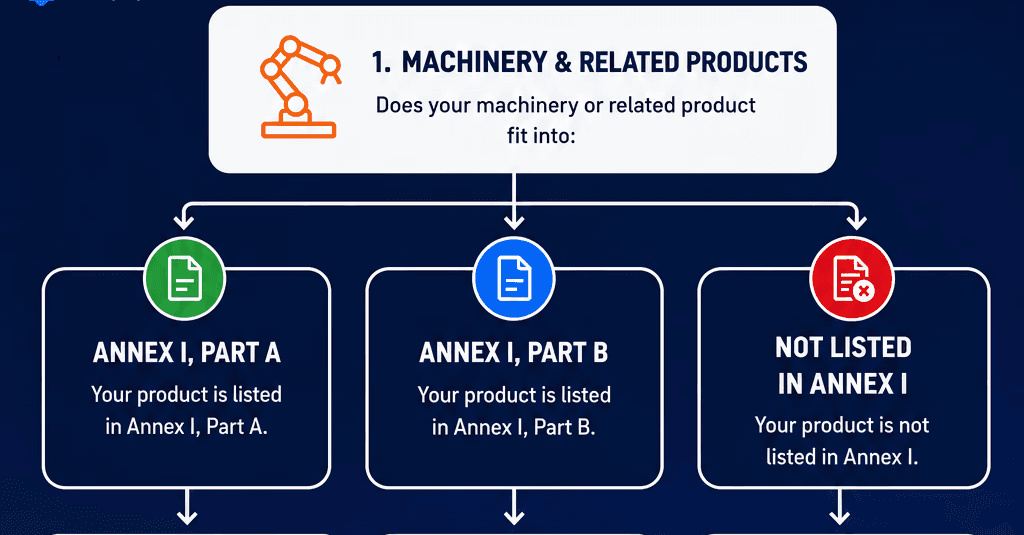
Annex IV becomes Annex I in the Machinery Regulation - what are the implications of this change?

Noex and SIS enter into a licensing agreement - standards integrated directly into the platform