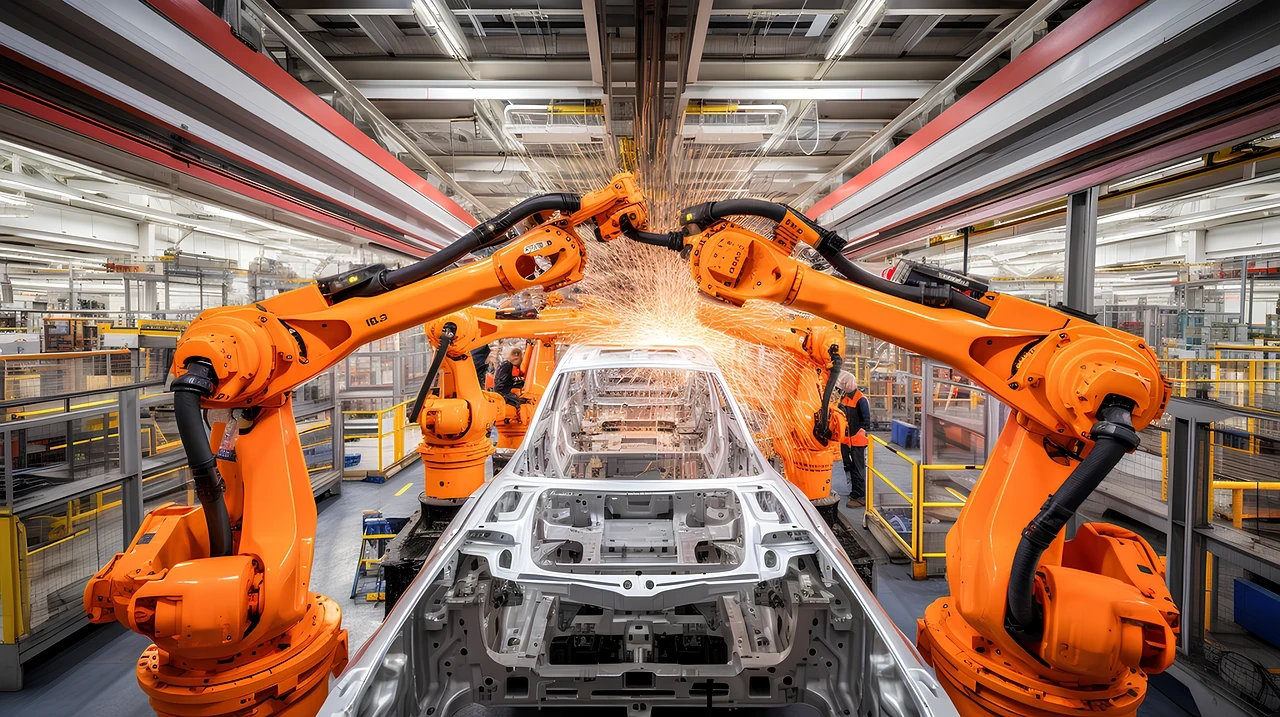
When developing machines, it is not enough to focus solely on function and performance. The design must also comply with safety principles according to international standards. The most central is ISO 12100:2010, which serves as a framework for risk analysis and risk assessment throughout the machine’s lifecycle.
In this article, we review the standard's methodology for risk reduction, how risks are classified, and the designer's role in the work with machine safety and CE marking.
General Principles According to ISO 12100
The standard emphasizes that the risk assessment must consider:
The intended use of the machine and the reasonably foreseeable misuse.
All phases of the lifecycle: design, transport, installation, operation, maintenance, and decommissioning.
Human interaction at each stage.
Ergonomics and user-friendliness, including control interfaces.
The process should be systematic, iterative, and well-defined.
Three-Step Strategy for Risk Reduction
ISO 12100 outlines a three-tier hierarchy, which must always be followed in order:
Inherently Safe Design Measures
Here, risks should be eliminated at the source through design, for example by:
Minimizing stored energy
Removing sharp edges
Restricting access to hazardous areas
Safeguarding and Complementary Safety Systems
When elimination through design is not possible, protection should be introduced, such as:
Fixed or movable guards
Emergency stops and safety switches
Light curtains and presence sensors
Information for Use
For remaining risks, clear information is required, such as:
Manuals and instructions
Warning signs and labeling
Recommendations for personal protective equipment
Training requirements
Risk Assessment Strategy
To conduct the risk assessment, ISO 12100 specifies the following steps:
Define the machine's boundaries and use
Identify risk sources and hazardous situations
Estimate risk level (severity x probability)
Assess if risk reduction is required
Implement measures according to the three-step model
Reassess remaining or new risks
The process is repeated until the risks are at an acceptable level.
The Designer’s Responsibility in Risk Reduction
The designer plays a central role in implementing protection measures and communicating residual risks.
This includes among other things:
Design changes and safety solutions
Documentation of risk assessment and actions
Technical files and user manuals
Classification of Risks
ISO 12100 contains a detailed list of hazards that can occur with machines.
Some examples:
Mechanical: Clamping, entanglement, falling parts
Electrical: Electric shocks, short circuits
Thermal: Burns from hot surfaces
Noise and Vibrations: Hearing damage, vibration injuries
Radiation: Laser, UV, or IR
Chemical Substances: Toxic or corrosive substances
Ergonomics: Poor working postures, repetitive movements
Environmental Factors: Dust, humidity, extreme temperatures
Combination Hazards: When multiple hazards interact
This classification can be seen as a checklist that helps designers avoid missing important risks during development work.
Conclusion
ISO 12100:2010 offers a clear and reusable method for:
Identifying and analyzing machine risks
Reducing risks step-by-step through design, protection, and information
Ensuring machines meet the requirements for CE marking.
By working according to the standard, companies can create machines that are not only efficient but also intrinsically safe and legally sustainable.
Would you like to see how Noex can digitalize the entire process for risk assessment and CE marking? Book a demo here!
FAQ - Frequently Asked Questions
Is risk assessment according to ISO 12100 mandatory?
No, it is not required to follow ISO 12100, but it is a fundamental A-standard crucial for meeting the safety requirements in the EU's Machinery Directive. The standard describes principles and methods for how risks should be assessed and reduced during design.
This constitutes a central part of the safety work required to meet the legal requirements for machinery according to the Machinery Directive (2006/42/EC) and the forthcoming Machinery Regulation (2023/1230).
What is meant by "intrinsically safe designs"?
That risks are eliminated already during the design stage, rather than just adding safeguards afterwards.
What types of risks are covered by ISO 12100?
Including mechanical, electrical, thermal, ergonomic, and environmental risks.
When does the machinery regulation come into effect?
The new Machinery Regulation (EU 2023/1230) will be fully applied starting January 20, 2027.
Machine Regulation 2023/1230 - Impact on Machine Manufacturers and Importers
Dec 16, 2025
Risk Analysis vs Risk Assessment - What is the Difference in Machine Safety and CE Marking?
Nov 11, 2025
Technical documentation according to the Machinery Directive – requirements, content, and responsibilities.
Oct 21, 2025