
Use of machinery at work - Employer responsibilities under Directive 2009/104/EC
Short summary
Machinery is subject to both product legislation and occupational health and safety legislation. While manufacturers are responsible for ensuring that machinery complies with applicable product requirements before it is placed on the market or put into service, employers have ongoing legal obligations making sure that machinery is used safely throughout its working life.
This article explains the employer's responsibilities under Directive 2009/104/EC, including the general obligations in Chapter II and the minimum requirements in Annex I and Annex II. You'll learn how to select suitable machinery, ensure its safe use, maintain compliance throughout its lifecycle, and document activities that support legal compliance.
You can access the complete text of Directive 2009/104/EC here.
What is work equipment?
Directive 2009/104/EC defines work equipment as any machine, apparatus, tool or installation used at work.
Although the Directive applies to many different types of work equipment, this article focuses on machinery, since machinery is subject to both European product legislation and work equipment legislation.
Typical examples include:
Production machinery
CNC machines
Robotic production cells
Conveyor systems
Packaging machines
Presses
Integrated machinery
Automated production lines
Example
A robotic welding cell, a CNC machining centre and an automated packaging line are all examples of work equipment within the meaning of Directive 2009/104/EC.
Why is machinery a special category of work equipment?
Machinery is unique because it is governed by two complementary legal frameworks.
Manufacturers are responsible for ensuring that machinery complies with applicable product legislation before it is placed on the market or put into service. This may involve the Machinery Directive 2006/42/EC or the Machinery Regulation (EU) 2023/1230, depending on when the machinery is supplied.
This also applies to integrated machinery (machinery assemblies or production lines), where several machines operate together as one functional unit. In many situations, the organisation integrating multiple machines into a complete production line assumes responsibility for the conformity assessment of the integrated machinery before it is put into service.
Once the machinery is used in the workplace, the employer becomes responsible for ensuring its safe use under Directive 2009/104/EC.
Remember
CE marking does not remove the employer's responsibilities. Employers remain responsible for how machinery is used, maintained, inspected and documented throughout its operational life.
Read our article about CE Marking of Machinery to learn more about the manufacturer's responsibilities.
Read our article about Machinery Assemblies to understand when several machines become one machine under European product legislation.
Employer responsibilities
Unlike product legislation, which primarily places obligations on manufacturers, Directive 2009/104/EC focuses on how employers manage machinery after it has been installed and put into service.
One of the most common misconceptions is that purchasing CE-marked machinery automatically fulfils an employer's legal obligations.
In reality, the employer has ongoing responsibilities throughout the machinery's working life.
Under Directive 2009/104/EC, employers must ensure that machinery:
Is suitable for the intended work.
Can be used without compromising workers' safety or health.
Is appropriate for the workplace and operating conditions.
Is maintained throughout its working life.
Is inspected whenever required.
Is supported by adequate information, instructions and training.
Is accompanied by appropriate documentation where required.
When selecting machinery, employers should consider:
The intended use.
The characteristics of the workplace.
Existing workplace hazards.
Additional risks introduced by the machinery itself.
If risks cannot be eliminated through the selection of suitable machinery, employers must implement appropriate measures to reduce those risks.
Example
The same machine may be suitable in one production environment but require additional protective measures when installed in another facility with different operators, workflows or surrounding equipment.
Inspection, maintenance and machinery modifications
Maintaining machinery in a safe condition is an ongoing responsibility.
Directive 2009/104/EC requires employers to ensure that machinery is maintained throughout its working life and inspected whenever necessary to verify that it remains safe to use. This includes:
Initial inspections after installation.
Inspections after relocation.
Periodic inspections.
Inspections following accidents or exceptional events.
Documentation of inspection results.
Documentation and inspections following modifications.
Whenever machinery is modified, employers should also review existing risk assessments and document how the modification affects machinery safety.
Inspection results should be recorded and retained as evidence of compliance throughout the machinery's operational life.
In some situations, a modification may constitute a substantial modification under European product legislation. If this is the case, the modified machinery may require a new conformity assessment before being put back into service, and the organisation carrying out the modification may assume the responsibilities of a manufacturer.
Noex enables organisations to document machinery modifications. It also helps users determine whether a modification may constitute a substantial modification requiring further assessment under the applicable product legislation.
Documenting Machinery Modifications in Noex

How Noex supports compliance with Directive 2009/104/EC
Complying with Directive 2009/104/EC requires employers to work systematically with machinery safety throughout the equipment's lifecycle.
Noex helps organisations document and manage:
Employer obligations
Applicable legal requirements
Machinery risk assessments according to ISO 12100
Inspection records
Machinery modifications
Corrective measures
Technical documentation
Compliance evidence
Rather than working with isolated documents, Noex brings legal requirements, risk assessments and documentation together in one platform, creating a structured and traceable compliance process.
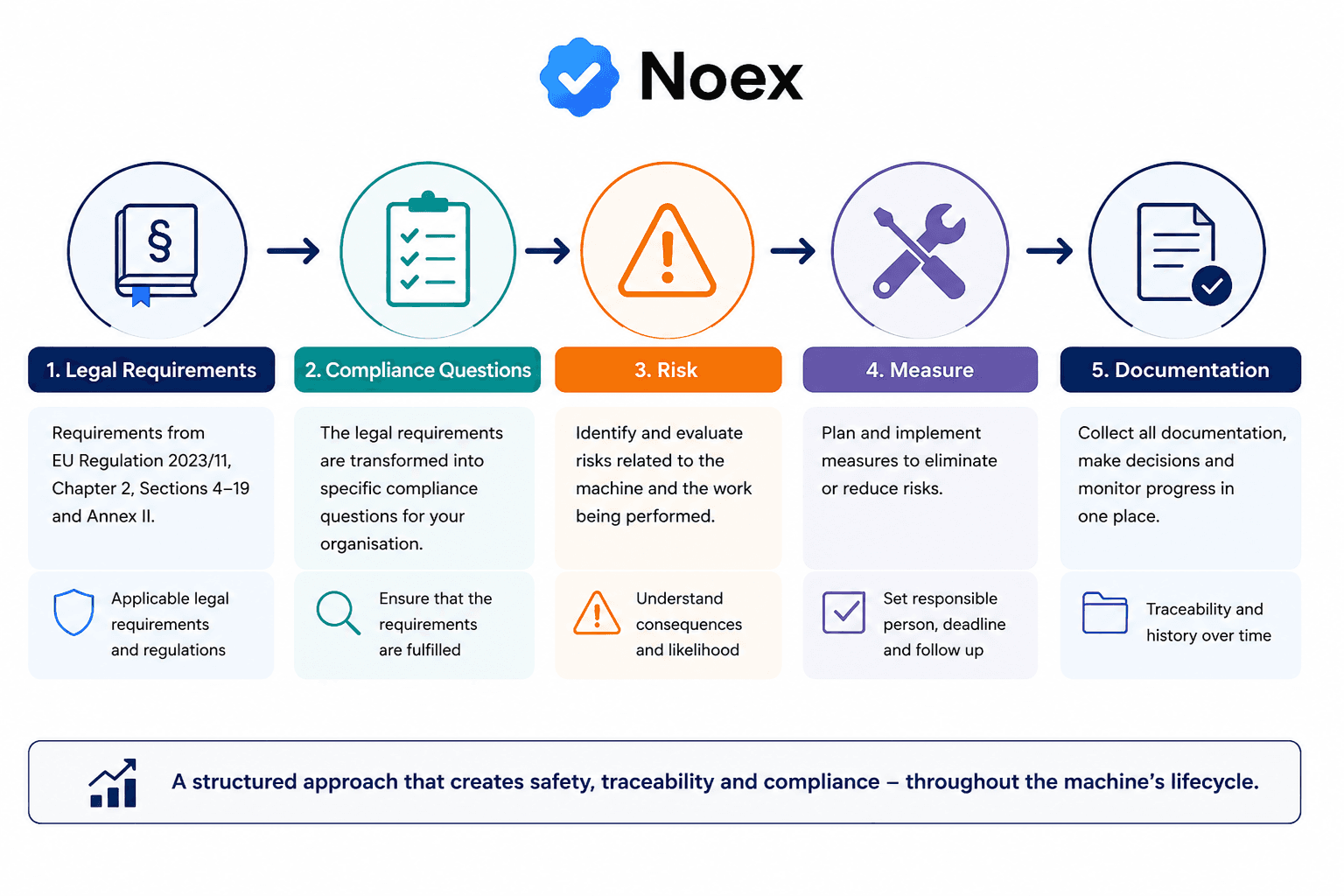
From legal requirements to corrective measures
Applicable legal requirements, compliance questions, risk assessments, corrective measures, responsibilities and supporting documentation are linked directly to each machine, providing complete traceability throughout the machinery's operational lifecycle.
Note
Noex supports organisations in documenting and managing machinery compliance under the Machinery Directive 2006/42/EC, Machinery Regulation (EU) 2023/1230 and the machinery-related employer obligations defined in Directive 2009/104/EC. Responsibility for complying with applicable legislation and national requirements always remains with the employer.
Summary
Safe use of machinery does not end with CE marking. Throughout the machinery's operational life, employers are responsible for selecting suitable machinery, ensuring safe use, maintaining equipment, carrying out inspections and documenting compliance.
By combining risk assessments, legal requirements, corrective measures and technical documentation in a structured process, organisations can more effectively demonstrate compliance with Directive 2009/104/EC while improving machinery safety and operational reliability.
Frequently Asked Questions
Does CE marking fulfil the employer's obligations?
No. CE marking demonstrates that the machinery complied with the applicable product legislation when it was placed on the market or put into service. Employers remain responsible for ensuring that the machinery is used, maintained, inspected and documented safely throughout its operational life in accordance with Directive 2009/104/EC.
Who is responsible for machinery after it has been installed?
Once machinery is put into service, the employer is responsible for ensuring that it remains safe to use. This includes selecting suitable machinery, carrying out risk assessments, providing information and training, maintaining equipment and performing inspections where required.
What does "work equipment" include?
Directive 2009/104/EC defines work equipment broadly as any machine, apparatus, tool or installation used at work. This includes production machinery, robotic cells, conveyor systems, presses, CNC machines and integrated machinery.
When should machinery be inspected?
Inspections should be carried out whenever required to ensure that machinery remains safe throughout its working life. This includes:
After installation
After relocation
Periodically where deterioration may occur
Following accidents or exceptional events
After modifications that may affect safety
Inspection results should be documented and retained as evidence of compliance.
What should be documented?
Employers should maintain documentation relevant to the safe use of machinery, including:
Risk assessments
Inspection records
Corrective measures
Machinery modifications
Technical documentation
Training records where applicable
Maintaining structured documentation helps demonstrate compliance and supports continuous improvement.
What happens if machinery is modified?
Whenever machinery is modified, the employer should review the associated risks and document the changes. In some cases, a modification may constitute a substantial modification under European product legislation, requiring a new conformity assessment before the machinery is put back into service. Noex guides the users in this field.
Does Directive 2009/104/EC apply to integrated machinery?
Yes. Once an integrated machine or production line has been put into service, the employer is responsible for ensuring that it is used safely, maintained and inspected in accordance with Directive 2009/104/EC, regardless of how many individual machines make up the assembly.
How does Noex support compliance with Directive 2009/104/EC?
Noex helps organisations manage machinery compliance by linking applicable legal requirements, compliance questions, risk assessments, corrective measures, technical documentation and supporting evidence to each machine. This creates a structured and traceable compliance process throughout the machinery's operational lifecycle.

