
The Real Cost of Word and Excel in CE Marking
How much of your specialist expertise is spent on document management instead of creating value?
For many machine manufacturers and manufacturing companies, the workload surrounding machinery safety, CE marking, and technical documentation grows over time. New templates are created, more documents are added, and more people become involved.
Initially, this setup often works well.
However, as the business evolves, so does the administrative burden. Documents must be updated, information collected, different versions managed, and new employees onboarded into the company's workflows.
Ultimately, administration starts consuming more time than the actual value-adding work – developing safe machinery, ensuring conformity with applicable harmonised standards and regulations, and keeping technical documentation complete, up-to-date, and traceable.
This is when many companies realise that the challenge is no longer about creating documentation. It is about aligning people, projects, and information in a unified manner.
Word and Excel are not the problem
Let us be clear from the start - Word and Excel/Spreadsheets are powerful tools and will continue to be a natural part of many companies' daily routines.
The programs themselves are not the issue.
The problem arises when they become the hub of a company’s machinery safety, CE marking, and technical documentation processes.
The risk assessment resides in an Excel sheet.
Checklists are kept in Word.
FAT/SAT protocols are filled out with pen and paper and someone forgot to scan them.
Photos are stored on mobile phones.
Comments are sent via email or Teams.
Manuals/Operating instructions are saved in a project folder..somewhere.
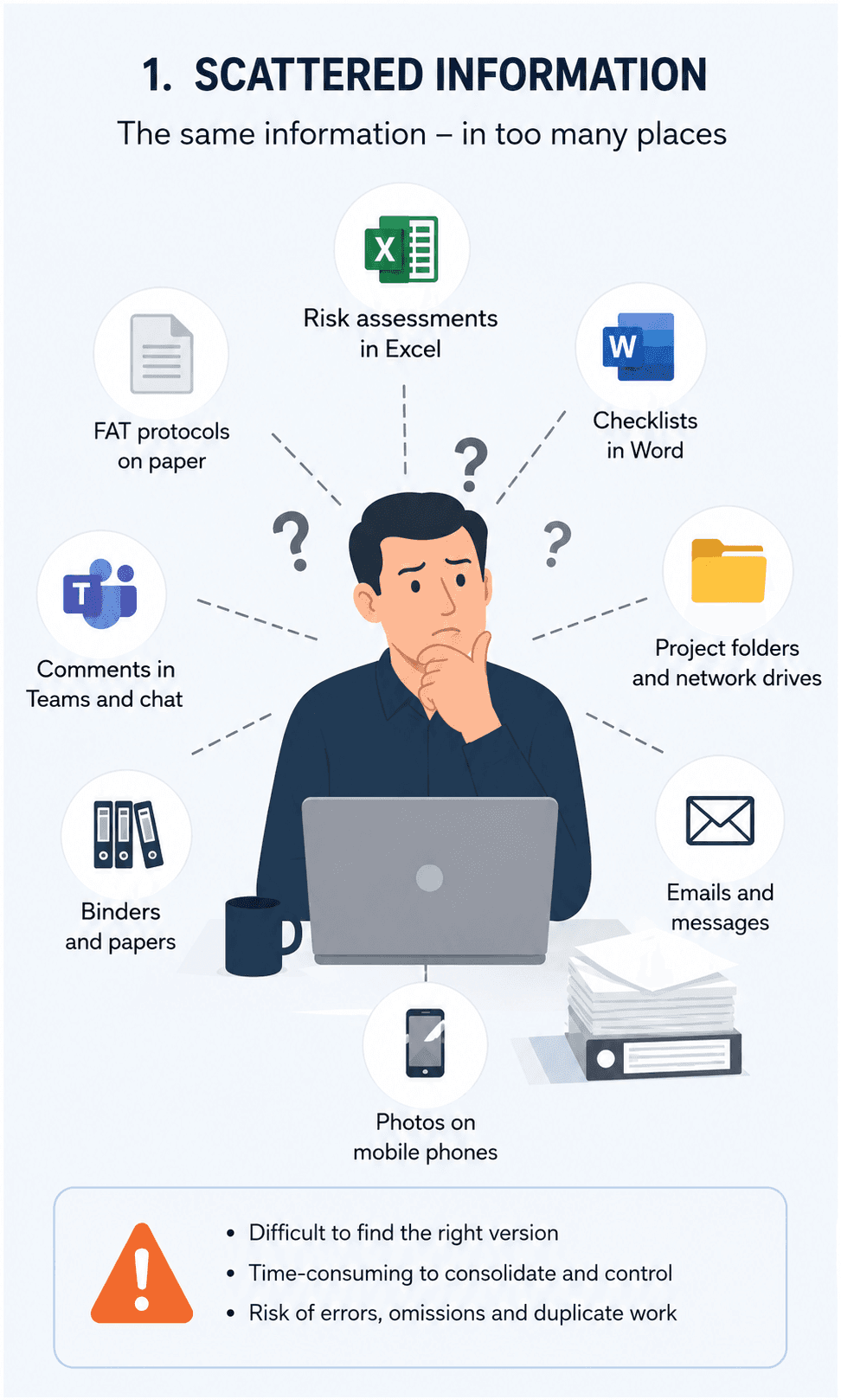
The information exists - but it is scattered across too many different silos.
And as more projects, team members, and modifications are introduced, ensuring that everyone is working with the correct, current information becomes increasingly difficult.
Small changes lead to major consequences
Almost every company starts with a master template. Then, someone introduces a minor improvement.
A design engineer adds a new field.
A project manager adjusts the structure.
Another project manager creates a local copy.
One factory site develops its own variant.
An external consultant uses their own template or tweaks an existing one.
No individual change is particularly significant.
But after a few years, a unified, standard template no longer exists - there are now several.
When the company subsequently wants to implement a new workflow or update the documentation to comply with new regulatory requirements, a difficult question arises:
Which template is actually the official company standard?
Information grows faster than the workflow
Machinery is becoming more complex.
Projects are growing in scope.
Regulatory requirements are changing.
More stakeholders are involved in projects.
At the same time, the volume of risk assessments, checklists, verifications, and technical files continues to expand.
The problem is rarely a lack of information.
The problem is that the volume of information is growing faster than the company’s methods for managing it.
This is when administration starts taking over - not because machinery safety engineering and technical documentation have inherently become more complicated, but because keeping the information coherent has become significantly harder.
Start by asking two simple questions
Before we look at the actual time lost, there are two questions that many companies struggle to answer.
How many Word and Excel templates, checklists, and other documents are actually in use across your organisation today?
And perhaps even more importantly:
How many of them do you need to review, update, and quality-assure before the new Machinery Regulation begins to apply on 20 January 2027?
Read more about the Machinery Regulation.
For many companies, the answer is far from straightforward.
Over the years, documents have been copied, adapted, and modified by various project managers, design engineers, production sites, and external consultants. What was once a single harmonised standard has gradually branched into multiple local variants.
The more time that passes, the harder it becomes to gain a consolidated overview of which templates and documents are actually in use, which are up to date, and which require updating.
And it is only when you begin to map out this scope that the real cost becomes clear.
What is the actual cost?
Let us look at a hypothetical, yet realistic example.
If you do not currently know how many templates, checklists, and other documents are used in your organisation, estimating the required effort is difficult. Let us assume, therefore, that the company uses around 20 document templates.
A machinery manufacturer completes 20 machinery projects per year.
For each project, time is lost to administrative tasks that do not directly add value.
Activity | Time |
Searching for the correct document and revision | 20 min |
Updating Word and Excel templates | 30 min |
Copying information between documents | 20 min |
Handling FAT/SAT protocols and hand-written notes | 30 min |
Sorting photos and attachments | 15 min |
Compiling the technical file for delivery | 20 min |
Quality assurance and double-checking | 25 min |
Total per project | 160 minutes (2 hours and 40 minutes) |
This equates to approximately 53 hours per year - more than an entire working week.
And this calculation does not even account for late design changes, missed items during delivery, post-audit rectifications, or the time lost when different engineers work on conflicting versions of the same file.
For the manufacturing industry, the reality is even more complex
Many companies procure production equipment which is subsequently modified, integrated, and upgraded over several years.
A robot is integrated.
A conveyor belt is modified.
Safeguards are retrofitted.
PLC programs are updated.
Sensors are relocated.
New operator stations are added.
Each change impacts the risk assessment, the technical file, and the company's liability to ensure that the assembly of machinery remains in conformity with key safety requirements.
After a few years, the same production line has undergone numerous modifications.
The crucial question then becomes:
Which documentation accurately reflects the plant as it actually exists today?
The more modifications that are executed, the more critical it becomes to maintain a robust change-management history and ensure all technical documentation is complete and up to date.
The Machinery Regulation means more than just a new rulebook
On 20 January 2027, the Machinery Regulation (EU) 2023/1230 becomes fully applicable.
You can read more about the Machinery Regulation here, and also see the precise changes in the Essential Health and Safety Requirements (EHSR) in our Academy's comparison table.
For many companies, this requires more than just understanding a new regulatory framework. It also means reviewing the documentation templates used every day:
Risk assessment templates.
Checklists.
Verification protocols.
FAT and SAT protocols.
Internal work instructions.
Project templates.
Training materials.
If reviewing, updating, internally approving, and implementing these changes takes an average of three hours per template, that equates to approximately 60 hours.
But reality is rarely that simple.
The same template often exists in multiple variants across different departments or production sites due to years of local modifications.
In such cases, the effort commonly escalates to 80-120 hours - another two to three working weeks lost.
The greatest cost does not appear in the project budget
It is easy to measure the time spent updating a single document.
It is much harder to measure the hidden costs:
When a new engineer needs to be trained on the company’s ad-hoc templates and procedures.
When a project manager is searching for the correct document minor revision right before commission delivery.
When a customer, notifying body, or market surveillance authority requests technical documentation from a project closed years ago.
When an experienced expert leaves, and the institutional knowledge of the company’s engineering workflows goes with them.
When two departments use different revisions of the same standard without realising it.
Each individual occurrence seems trivial - combined, they represent a significant cost.
A unified workflow is about more than just documents
Companies rarely choose to modernise their workflows because Word or Excel are inherently bad tools.
They do so because the organisation needs to operate more consistently.
When machinery safety, CE marking, and technical documentation are managed within a unified platform, it becomes easier to:
Implement a harmonised process across the entire organisation,
Ensure that everyone uses the latest approved templates and procedures,
Collaborate across sites, departments, and engineering teams,
Onboard new team members quickly,
Retain engineering knowledge and design intent when personnel changes occur,
Efficiently manage new regulatory requirements and state-of-the-art standards,
Maintain full traceability and machinery lifecycle history for every project.
It is not about generating more paperwork.
It is about establishing robust process control.

Summary
Word and Excel will remain important tools in the future.
However, when they serve as the primary framework for machinery safety, CE marking, and technical file compilation, administrative overhead increases rapidly.
In our example, routine document management corresponds to roughly 53 hours per year.
Add to that the preparation work for the upcoming Machinery Regulation, and the total time consumed can easily reach 133-173 hours.
This represents more than three to four working weeks where your organization's most valuable engineering expertise is spent on administrative tasks rather than value-generating safety engineering.
The key question is therefore not whether Word and Excel are functional.
The key question is:
How much of your specialist expertise do you want to spend administering documents - instead of developing systems, ensuring compliance, and creating value for your organisation and your customers?
And perhaps it is time to ask two final questions:
How many Word and Excel templates do you use in your organisation today?
And how many of them must be updated before 20 January 2027?
If the answer is unclear, the challenge may not be the documentation itself - but the workflow.
Noex does not replace Word and Excel. Noex unifies people, projects, and compliance documentation into a single centralised platform.
Want to see how other machine manufacturers and industrial companies have centralised their machinery safety and CE marking processes? Book a free demonstration of Noex by sending us an email to hej@noex.se.
Frequently asked questions about Word, Excel spreadsheets and CE marking of machinery.
Are Word and Spreadsheets approved for CE marking?
Yes. There are no regulatory requirements prohibiting the use of Word or Excel spreadsheets for CE marking. Many companies utilize them for risk assessments, verification checklists, and technical documentation.
The challenge arises as the volume of documentation increases, when multiple contributors collaborate on the same project, or when different versions of documents begin to circulate.
Is Excel sufficient for risk assessments according to EN ISO 12100?
Excel can be used to document a risk assessment; however, as the number of projects, identified hazards, and risk reduction measures increases, ensuring traceability, revision control, and a standardized methodology becomes highly challenging.
What is the main disadvantage of using Word and Excel for CE marking?
The primary issue is rarely the software programs themselves.
Rather, it is that information often becomes fragmented across various documents, folders, emails, and personnel. This makes it difficult to maintain and ensure up-to-date, traceable, and consistent documentation.
How does the new Machinery Regulation impact companies using their own templates?
With the application of the Machinery Regulation, many economic operators and manufacturers must review and update their risk assessment templates, verification protocols, checklists, and other technical files.
If identical templates exist in multiple in-house versions or are applied inconsistently across different engineering departments, executing these updates becomes highly time-consuming and difficult to quality-assure.
How can the administrative burden of CE marking be reduced?
One effective approach is to consolidate risk assessments, technical files, verifications, risk reduction measures, and project-specific data within a unified, centralized platform.
This minimizes the need for manual updates, streamlines engineering collaboration, and ensures all stakeholders work with the same, current data set.
When should a company transition from Word and Excel to a centralized digital solution?
There is no single fixed threshold.
However, many manufacturers choose to centralize their processes when they realize that:
technical documentation is fragmented across multiple storage locations,
different departments or business units use divergent templates,
establishing the current, valid document revision is highly difficult,
onboarding new safety engineers requires extensive training and induction,
administrative tasks consume an increasing amount of time that could be spent on value-added engineering.
Are centralized platforms intended only for large companies?
No.
The necessity is not primarily determined by organizational size, but by the complexity of the machinery safety compliance process, the CE marking workflows, and the management of the technical file.
Even SMEs benefit significantly from a standardized workflow when multiple engineers collaborate on compliance documentation, or when machinery undergoes modifications and significant changes over its lifecycle.
What are the benefits of centralizing machinery safety compliance and CE marking workflows?
A centralized solution simplifies the ability to:
standardize processes across the entire organization,
reduce dependency on individual experts and mitigate institutional knowledge loss,
ensure robust traceability and revision control,
streamline the onboarding of new engineering team members,
efficiently adapt to amendments in harmonized standards and regulatory requirements,
maintain a consolidated, aggregate overview of each machine and project status.
This frees up valuable engineering and safety specialist resources to focus on core tasks: system design, functional safety, and regulatory compliance.


